Cloud migration has become a strategic move for organizations across Southeast Asia, eager to capture the flexibility, scalability, and cost savings that cloud environments offer. Thailand is a good example of just how fast this market is growing: AWS launched its Asia Pacific (Thailand) Region in January 2025, committing over US$5 billion to build out cloud infrastructure in the country, while Google announced its own US$1 billion plan in October 2024 to establish a data center and cloud infrastructure there.
But as more companies move to multi-cloud environments as part of that migration — leaning on AWS, Google Cloud, and Microsoft Azure together — managing that environment has become increasingly difficult. A well-executed multi-cloud strategy, often paired with on-premises or local colocation, delivers real benefits in scalability, performance, compliance, and continuity. Those benefits come bundled with new challenges too: operational complexity, interoperability headaches, and heightened security concerns.
This piece looks at the benefits of multi-cloud management, the challenges organizations run into, and how MQloud — an intuitive, user-centric multi-cloud management platform — simplifies the whole process, so businesses can spend their energy on innovation instead of juggling cloud operations.
Businesses can spend their energy on innovation instead of juggling cloud operations.
Why a Multi-Cloud Strategy at All?
Businesses are increasingly drawing on multiple cloud services from different providers, and it's easy to see why. This approach avoids dependency on any single vendor and boosts resilience by spreading workloads and resources across platforms.
A multi-cloud strategy also lets businesses allocate workloads and resources across different platforms to maximize efficiency while tailoring infrastructure to specific needs. On top of that, it lets businesses shift between platforms as needed, avoiding vendor lock-in and continuously optimizing resources.
The Challenges That Come With Multi-Cloud
Even with its clear advantages, managing multiple clouds can get complicated fast — across operations, performance monitoring, and cost management alike.
- Setup and operations: handling different platforms, tools, and environments places a real burden on IT teams. Each cloud service comes with its own interfaces, APIs, and security configurations, raising the odds of human error and complicating daily operations. Keeping interoperability and consistent security across platforms introduces additional risk on top of that.
- Performance monitoring: optimizing performance across multiple infrastructures demands sophisticated tools and real expertise. IT teams have to monitor in real time, address bottlenecks as they appear, and keep operations running smoothly across every cloud environment.
- Cost management: while multiple providers can offer real cost advantages, they also complicate expense tracking and optimization. Businesses need one unified way to monitor usage, control costs, and head off unexpected charges across every provider.
Why Multi-Cloud Management Tools Matter
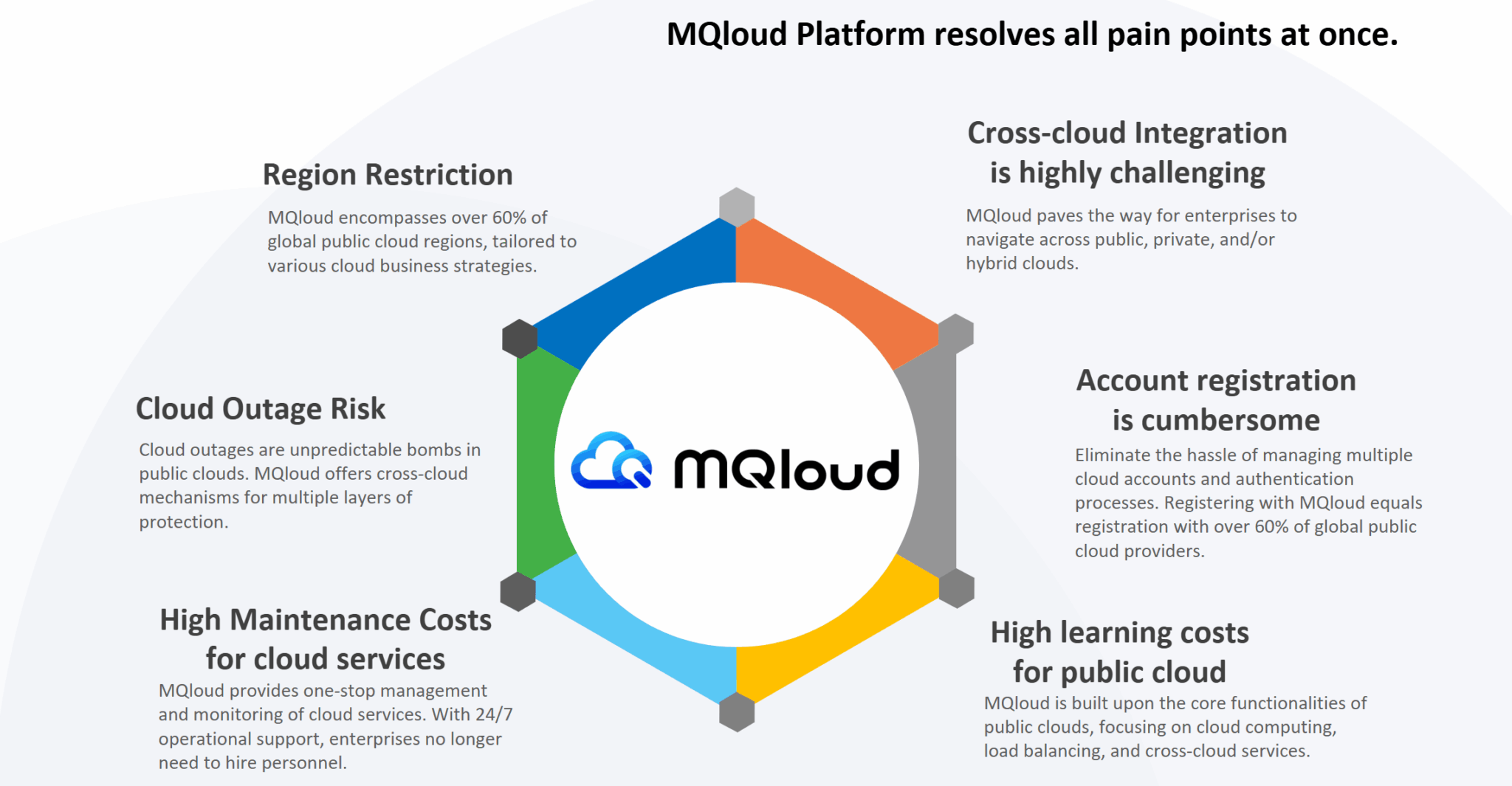
Given the complexity of managing multiple cloud environments at once, an effective multi-cloud management platform like MQloud becomes genuinely essential. MQloud simplifies operations by seamlessly integrating services from AWS, GCP, Azure, and others into a single, user-friendly platform — streamlining setup, ensuring smooth connectivity, consolidating billing, and simplifying permission management, so businesses can efficiently oversee and optimize their entire cloud footprint.
Key Features
- Unified interface: instead of manually navigating separate interfaces for AWS, Azure, or GCP, MQloud provides one unified interface for initiating and managing accounts across multiple cloud providers from a single dashboard.
- Cross-cloud connection: facilitates true cross-cloud integration, letting businesses deploy services across different clouds while maintaining business continuity.
- Automated provisioning: automates account creation by pre-configuring settings like access controls, security policies, and compliance requirements for new accounts across cloud services, cutting down manual steps and errors.
- Standardized configuration: enforces standardized security policies, resource allocation, and governance rules during account setup, keeping every account consistent from day one.
- Simplified billing setup: consolidates billing information from the start, making it far easier to set up accounts and track costs without configuring separate billing details per provider.
- Role-based access and permissions: pre-configures role-based access controls across new accounts, so the right people get the right access and quota authorization without manual adjustment per cloud provider.
- Granular performance monitoring: an integrated dashboard delivers real-time, granular visibility across every cloud environment, so businesses can track and optimize resource usage and application performance from one place.
Why MQloud Represents the Future of Multi-Cloud Management
As businesses continue to scale and migrate into multi-cloud environments, managing services across multiple platforms only gets more challenging. MQloud offers a genuinely different approach — simplifying cloud management, optimizing costs, and providing seamless connectivity across AWS, GCP, and Azure. Its integration, simplification, and connectivity together let businesses focus on innovation, confident that their cloud operations are being managed well behind the scenes.